Institution KYB
Why
Within its commercial network, Tauraco must speak only to genuine financial institutions authorized to lend. This process organizes the building of the file that proves it, before the institution can receive a single request.
How, in the application
A partner institution has no dedicated table: it is represented by the combination of a tenant, an identity in the shared counterparty registry, a declared qualification, and a network enrollment — adding a separate table would have created a second source of truth on "who is this bank." The authorization number entered at registration is a plain declaration: no function queries an external bank registry to verify it, and the qualification created is always born non_validee (not validated).
The institution submits its KYB file (regulator's authorization, articles of association, RCCM registration, director's identity document) through its own routes, deliberately accessible before it even holds the financial-institution qualification — requiring it at this stage would create an impossible situation where a pending institution could never become one. The file follows a simple cycle: a submission moves it to SUBMITTED; only status APPROVED permanently closes the possibility of a new submission — a rejected file can always be resubmitted.
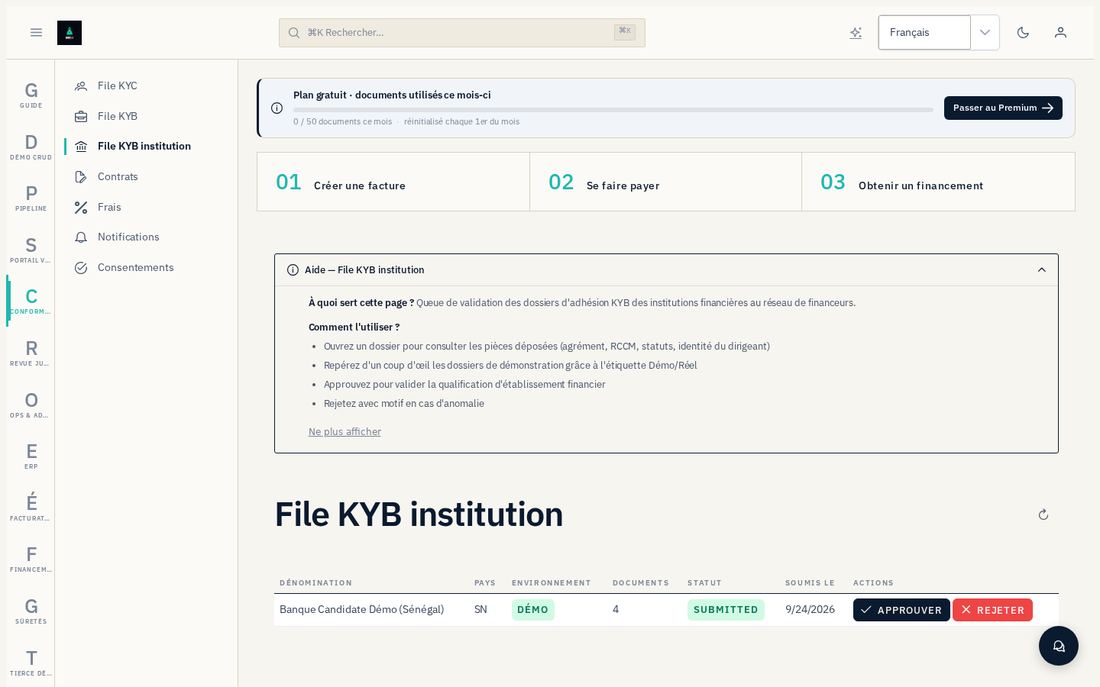
A queue dedicated to the compliance team lists submitted or under-review files. Approving a file does two things in a single act: it moves the file to APPROVED and promotes the counterparty's financial-institution qualification to validee (validated) — it is this promotion, and this alone, that opens the entire set of bank cockpits to the institution (received files, offers, competitive position, market ranges).
Safeguards
- The administration that creates, suspends, or invites an institution's users never opens access to its private commercial files — even a platform administration role never enters institutional-context resolution.
- Validating a qualification is a human, tracked act, never automatic: nothing in the system can promote an unverified declaration by itself.
- Approving an already-complete file requires the mandatory documents to actually be uploaded — approval checks completeness before promoting anything.