Competitive position & market ranges
Why
A bank needs a benchmark to situate its own offer relative to the market — without this ever amounting to exposing its competitors' individual offers, which would amount to organizing price-fixing.
How, in the application
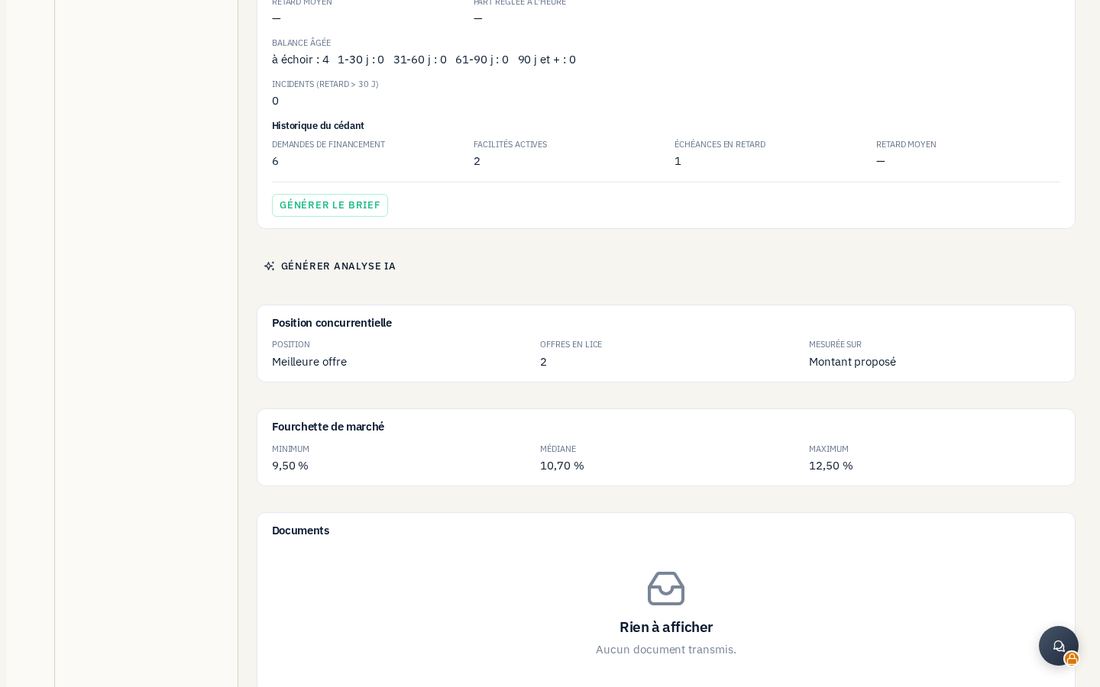
Two distinct mechanisms, never conflated. Competitive position situates a bank on a specific file, including its own offer in the comparison — it is a comparison of self against others. The market range, on the other hand, aggregates the conditions offered by other institutions on a segment (country, product, currency, maturity tranche), over a rolling twelve-month window, and explicitly excludes any offer from the calling bank from its own calculation.
The range is only published if a k-anonymity threshold is reached: at least three offers, from at least three distinct institutions. Below that, no partial range is returned — only an indication that the threshold has not been reached. The published result is limited to a minimum, a median, and a maximum, in basis points.
The isolation between the real network and the demo network is respected at this level too: the environment class used for the calculation is that of the querying institution, never that of an individual offer — an offer has no environment class of its own.
Safeguards
- The minimum threshold of three offers and three distinct institutions is a strict condition, never relaxed to display a partial result.
- The number of institutions shown in a market range is a twelve-month segment aggregate — never a count of competitors on a specific file, a notion that belongs exclusively to competitive position.
- No link is ever built between this market calculation and a particular file's third-party-custody or collateral data.