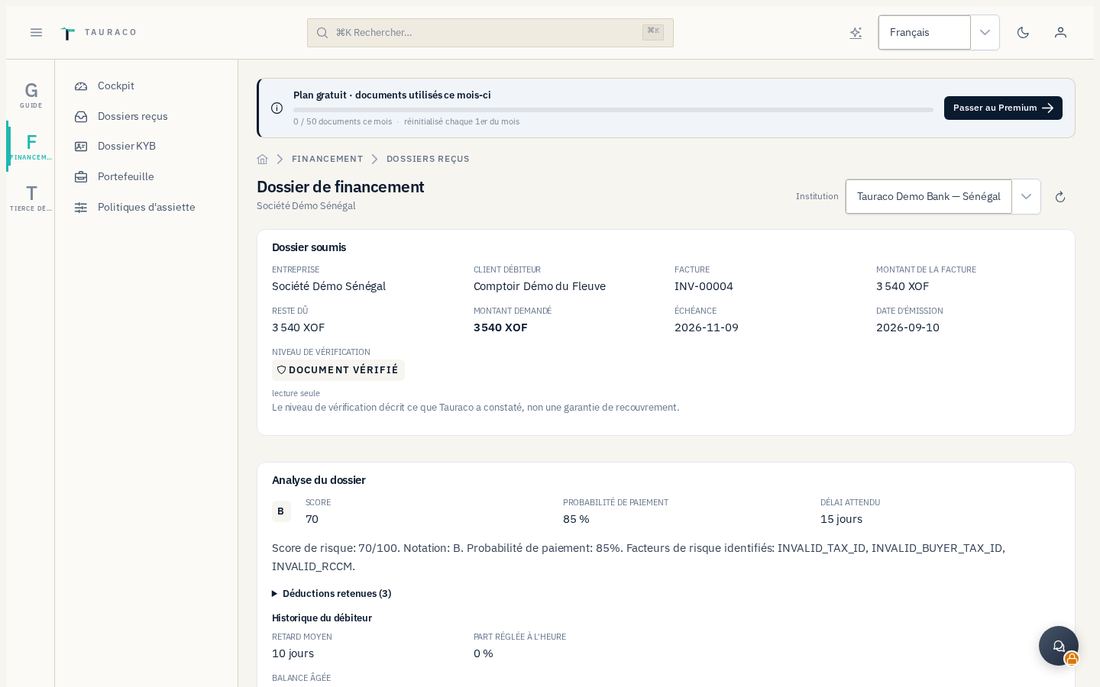
File analysis
Why
A bank receiving a request knows neither the debtor nor the history of the commercial relationship between the assignor and its customer. This process reconstructs verifiable facts — payment history, risk indicators — to reduce this information asymmetry, without ever substituting itself for a credit judgment that only the bank can make.
How, in the application
History reconstructed "as of a date." An invoice is considered settled at a given date only if the sum of payments actually made before that date covers its full amount — never because its current status says so. A payment made after the reference date is ignored: querying the same history twice at the same date always produces the same answer. A delay is treated as an incident only if it strictly exceeds thirty days; a debtor is flagged as slow if its average delay exceeds fifteen days. Every published aggregate carries its calculation formula in plain words, never a plausible-looking value computed on an empty sample.
Grade, score, and payment probability. The scoring engine produces a grade, a numeric score, and a payment probability, as well as an expected delay and risk signals. Each new analysis creates a distinct, versioned row — never an in-place correction of a prior analysis.
Named and transparent. Unlike the anonymized investor market (see process 15), this analysis carries the debtor's and the assignor's real identity: it is visible to every bank that received the request, and to the company itself, which always sees its own analysis. Only a summary drafted by artificial intelligence, cached, remains reserved to the bank.
IBAN neutralized. An explicit product decision disables the bank-account consistency check in the risk calculation: African IBANs are neither reliable nor connected to a clearing system that could genuinely validate them, and checking them would give a false sense of control. No analysis therefore carries an IBAN-related penalty.
Safeguards
- The analysis calculation is wrapped in its own database savepoint: its failure never blocks the submission of the financing request.
- The history is never rewritten — a new version is added, the old one remains viewable.
- The company has guaranteed, permanent access to its own analysis: transparency toward the assignor is not a display option, it is structural.