Documentary Collateral & verification limits
Why
To present assets and proposed security interests to a bank, the company needs consistent, up-to-date supporting documents. The Collateral module organizes documents for a contract, receivable, inventory, or equipment, flags inconsistencies, and prepares a summary for file review. These checks concern documents: calculating a borrowing base and legally validating a security interest require separate procedures.
How, in the application
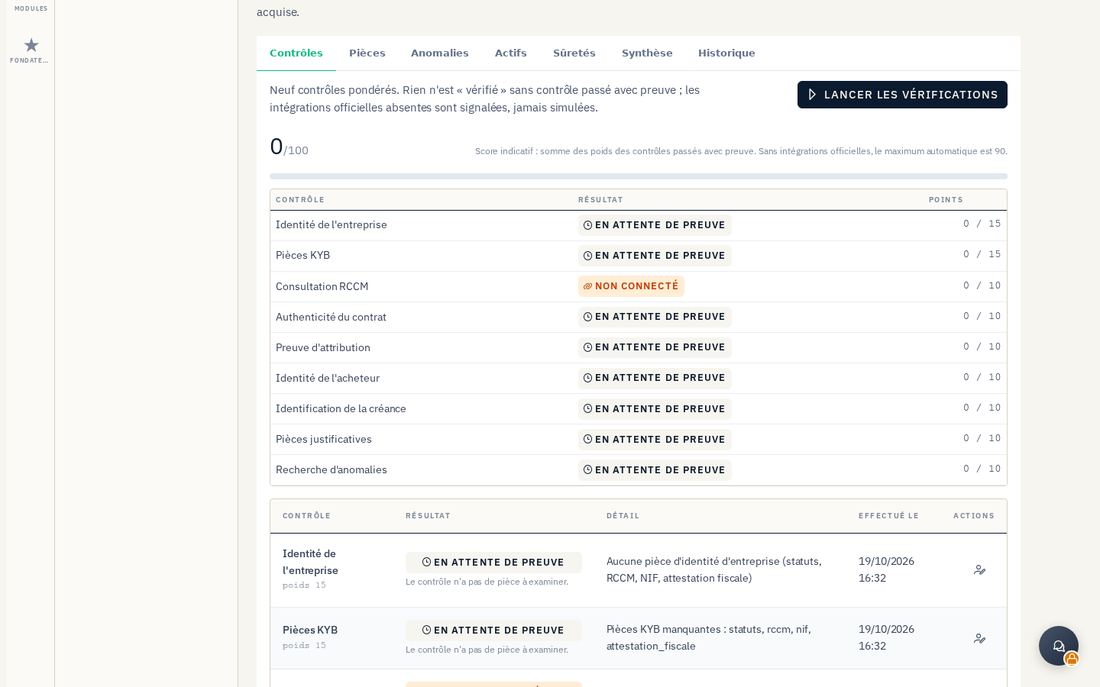
Gather and check. The file brings together parties, amounts, company documents, contract or award evidence, and documents specific to the asset. Checks look for inconsistencies in declared identities, amounts, currencies, and dates, as well as duplicates. The reliability score presents the points earned and their supporting documents. It is a documentary score, not a credit rating or a collection guarantee.
Keep verification current. A material file change or a new document invalidates previous checks. They must be rerun, and any required manual reviews renewed. Earlier results remain in the history; their previous score must not be applied to new documents.
Declare security-interest stages. Tracking distinguishes proposed security, declared creation, declared registration, declared enforceability, and declared release. Every transition after the first requires a document from the file, with its presence and integrity checked. References, dates, and authors make the declaration traceable. The file manager records progress; that role in Tauraco does not by itself confer external legal authority.
Prepare a summary file. The summary brings together checks, documents, proposed assets, declarations, and alerts for human review. Preparing an asset does not transmit it to the financing module or include it in a borrowing base: transmission between these modules is unavailable. A manually entered asset reference remains a declared, unverified link.
Safeguards
- A PDF's presence and fingerprint allow the retained file to be checked; they establish neither the validity of its content nor the signer's authority.
- The documentary sequence is not a universal legal procedure. Applicable documents and formalities must be confirmed by the competent parties for the instrument concerned.
- An application without an award is not an acquired receivable. A contract or a declared inventory value does not replace specialist invoice and goods checks.
- Closing a documentary alert after a declared release does not prove that a registry or beneficiary has confirmed that release.